For I Know the Plans I Have for You” — What This Promise Really Means When Your Life Feels Like Exile
It might be the most quoted, most printed, most tattooed Bible verse in the English-speaking world. It appears on graduation cards and hospital room walls, on coffee mugs and phone cases, stitched onto pillows and painted onto canvases in farmhouse kitchens across the world. And it is genuinely beautiful — because it is genuinely true. But most people who quote it have never been inside the story it came from. And that is a tragedy. Because when you understand where these words were spoken, and to whom, and under what circumstances — the promise does not shrink. It becomes ten times bigger than a coffee mug can hold.
Jeremiah 29:11 was not spoken to a person on a good day, riding high on answered prayers and visible blessings. It was spoken to a people in exile. A people who had lost their city, their temple, their freedom, and — many of them thought — their God. It was spoken into one of the darkest seasons in Israel’s entire history.
And that is precisely what makes it so powerful. Because if God could say “I know the plans I have for you” in that darkness — He can say it in yours too.
· · ✦ · ·
“For I know the plans I have for you,” declares the Lord, “plans to prosper you and not to harm you, plans to give you hope and a future.”— Jeremiah 29:11 (NIV)
Before the Promise — The Setting
You Have to Know Where This Was Written
To understand Jeremiah 29:11, you need to understand Jeremiah 29. And to understand Jeremiah 29, you need to understand what had just happened to the nation of Israel.
In 605 BC, the Babylonian king Nebuchadnezzar invaded Jerusalem. He came back again in 597 BC and this time carried away thousands of Israelites — the priests, the nobles, the skilled workers, the leaders — into captivity in Babylon. The city they loved was still standing, but they were gone. Stripped from their homes, their community, their land, their temple — everything that had shaped their identity as God’s people.
And then the false prophets started speaking. Men who stood up among the exiles and said: “Don’t worry. This won’t last long. God will break the yoke of Babylon within two years. You’ll be home soon.” (Jeremiah 28:2–4) It sounded like faith. It sounded encouraging. It was exactly what everyone wanted to hear.
It was also completely false.
Into this situation, God sent a letter through Jeremiah. Not a letter of rescue — not the news everyone was waiting for. Instead, a letter with the most counterintuitive instruction imaginable:
“Build houses and settle down; plant gardens and eat what they produce. Marry and have sons and daughters… seek the peace and prosperity of the city to which I have carried you into exile. Pray to the Lord for it, because if it prospers, you too will prosper.”— Jeremiah 29:5–7 (NIV)
In other words: stop waiting for the quick rescue that isn’t coming. Plant trees you may never sit under. Build homes in a foreign land. Pray for the nation that enslaved you. Settle in. Because you are going to be here for seventy years.
Seventy years. Most of the people who heard that letter would die in Babylon before it was over. The promise of return was not for them personally — it was for their children, and their children’s children.
And then — in the middle of that hard, long, inconvenient, faith-stretching instruction — God says: “For I know the plans I have for you.
That context does not weaken the promise. It is what gives it its weight. God was not speaking comfort into easy circumstances. He was speaking it into seventy years of waiting. Into the darkness of a generation that would not see the fulfilment. Into a letter that told people to put down roots in a place they never wanted to be.
· · ✦ · ·
Hebrew Word Study
Three Words That Change Everything
When you read Jeremiah 29:11 in English, you are reading a translation. But the original Hebrew carries layers of meaning that most English versions cannot fully capture. Three words in particular deserve your attention — because they tell you exactly what God was promising, and what He was not.
שָׁלוֹםShalom
“Plans to prosper” — but shalom means far more than prosperity. It means wholeness, completeness, peace, well-being. Not wealth, but flourishing.
תִּקְוָהTiqvah
“Hope” — but the Hebrew carries the image of a cord or thread. A lifeline. Something to hold onto even when you cannot see where it leads.
אַחֲרִיתAcharit
“Future” — literally “the latter end.” What comes after. The destination toward which everything is moving, even the painful parts.
God’s promise was not “I will make you wealthy and comfortable.” It was “I will bring you to wholeness. I will give you a cord to hold in the dark. And there is a latter end — a destination to this journey — even though you cannot see it from here.”
The word translated “plans” is the Hebrew machashaboth — meaning thoughts, purposes, intentions that have been carefully considered and will not be abandoned. These are not impulsive plans. They are not plans that circumstances can derail. They are the settled, purposeful, deeply considered intentions of a God who knows the end from the beginning.
And the word “know” — yada — is the most intimate word for knowledge in Hebrew. It is the same word used of a husband knowing his wife, of God knowing Moses face to face. This is not detached, clinical knowledge. It is the knowledge of deep relationship. God knows these plans the way He knows you — personally, completely, with full awareness of every detail.
· · ✦ · ·
Why the Context Matters So Much
What the Exiles Were Actually Feeling
Because this promise was not given in a Sunday school setting
To feel the full force of Jeremiah 29:11, you need to sit inside the experience of the people who first heard it. These were not people in mild inconvenience. They had lost everything — in the most complete sense of that phrase.
What the Exiles Had Lost
- Their homeland — Jerusalem, the only home they had known
- Their temple — the place where God’s presence dwelt
- Their freedom — they were captives in a foreign empire
- Their community — families torn apart, leaders removed
- Their sense of identity as God’s chosen people
- Their expectation of a quick rescue — the false prophets had lied
What God Spoke Into That Loss
- “I know the plans I have for you” — not have had, not will have. Present tense. Now.
- Plans for shalom — for your wholeness and well-being
- Not for harm — your suffering is not my intention for you
- A tiqvah — a lifeline to hold in the darkness
- An acharit — a future destination, even through the 70 years
- “When you seek me with all your heart, you will find me” (v.13)
The false prophets had promised two years. God promised seventy — and then restoration. The false prophets gave people what they wanted to hear. God gave them what they needed: not a quick exit from the pain, but a reason to keep living faithfully inside it. Not a rescue from Babylon, but a purpose within it.
And that distinction is enormously important for anyone reading this verse in a hard season today.
· · ✦ · ·
Getting It Right
Three Common Misunderstandings of This Verse
And what the verse actually means instead
✕ Misreading 1: “This verse means God will never let bad things happen to me.”
What it actually means: It was spoken to people in the middle of seventy years of hardship. The promise was not the absence of difficulty — it was God’s sovereign purpose within the difficulty. Bad things were happening. God was still for them. Both are true at the same time.
✕ Misreading 2: “This verse promises me personal material prosperity and career success.”
What it actually means: The word “prosper” translates shalom — peace, wholeness, and well-being. God was not promising wealth. He was promising that His purposes would bring His people to a place of completeness and flourishing — which is something far deeper and more lasting than money or success.
✕ Misreading 3: “This verse means I should expect my situation to change quickly.”
What it actually means: God told the exiles to plant trees, build houses, and pray for their captors — because they were going to be there for a generation. The promise was not a quick exit. It was a purpose for the long road. The “future and a hope” could require a very long journey to reach.
✓ What the verse is genuinely promising:
God has not lost the plot of your story. Even in the hardest, longest, most confusing season of your life — His plans are in place. His intentions toward you are for your wholeness, not your destruction. There is a latter end. There is a destination to this road. And He knows exactly where it leads, even when you cannot see past today.
· · ✦ · ·
The Verses Nobody Quotes — Jeremiah 29:12–13
The Promise Comes With a Path
Most people stop at verse 11. But God didn’t stop there. The very next words tell us how the promise is accessed — and they are just as important as the promise itself:
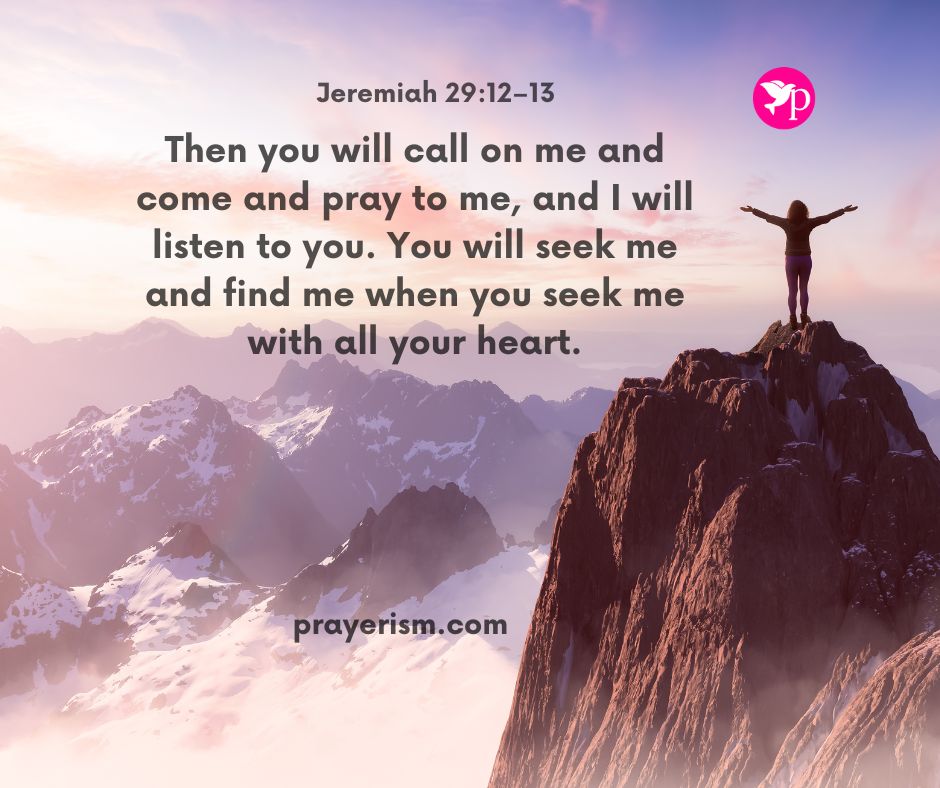
“Then you will call on me and come and pray to me, and I will listen to you. You will seek me and find me when you seek me with all your heart.” — Jeremiah 29:12–13 (NIV)
The path into the promise runs through prayer and wholehearted seeking. God was not saying: “Sit back, stop engaging with me, and watch the plan unfold.” He was saying: “Call on me. Come and pray. Seek me with everything you have — and you will find me.”
This is the invitation embedded inside the promise. The plans God has for you are not passive — they are engaged through active, persistent, wholehearted relationship with Him. The future and the hope are not a package that arrives at your door while you wait. They are discovered in the journey of seeking the One who holds them.
The exiles who experienced restoration were the ones who, in the seventy years of waiting, kept praying. Kept seeking. Kept calling out. Daniel prayed three times a day facing Jerusalem. The community kept its faith. And when Cyrus issued his decree and the doors of Babylon opened — they were ready. They had been walking toward the promise the whole time.
· · ✦ · ·
What This Means for Your Own “Exile Season”
Because most of us know what it is to feel displaced, lost, or stuck in a place we never chose
You may not be in Babylon. But you may be in something that feels just as disorienting, just as far from where you thought you’d be by now, just as resistant to a quick resolution. Here is what Jeremiah 29:11 says into the specific seasons most people carry:
💔When a door has closed permanently
The career that ended. The relationship that broke. The dream that didn’t happen. God says: I know my plans. This door closing is not the end of the story. There is an acharit — a latter end — to this road.
⏳When the waiting has gone on too long
The prayer still unanswered. The healing that hasn’t come. The promise that feels impossibly distant. God says: I am not slow. My timing is purposeful. The seventy years are not an accident. And I will be found if you keep seeking.
🌿When you are in a place you never chose
The city you didn’t want to move to. The season of life you didn’t plan for. The circumstance forced on you by someone else’s choices. God says: settle in. Plant your garden here. I am in this place too.
🌑When false voices are the loudest ones
The voices that promise quick fixes, easy answers, and two-year deliverances that aren’t coming. God says: listen to the letter, not the false prophets. The real promise is harder and truer and worth more.
🙋When you’ve made a catastrophic mistake
Israel was in Babylon partly because of their own sin. God still said “I know the plans I have for you.” His purposes are not cancelled by your failures. He is the God of the latter end, not just the beginning.
🔥When the plan feels like it skipped you
Everyone around you seems to have their future figured out. You feel overlooked, forgotten, passed by. God says: I know the plans. Not past tense. Present tense. I know them now. They are in place for you — specifically, personally, right now.
· · ✦ · ·
How to Actually Hold Onto This Promise When Life Doesn’t Look Like It
Five practices drawn from the exiles themselves
- Pray anyway — call on Him even when you can’t feel HimVerses 12–13 are the path into the promise. Don’t wait until you feel like praying. Don’t wait until the situation looks more hopeful. Call on Him now, in the middle of the Babylon, with whatever prayer you can manage. He has promised: “I will listen to you.” That promise is unconditional.
- Plant your garden — invest faithfully in the season you’re inGod told the exiles not to hold life at arm’s length while waiting for things to change. He told them to plant, build, marry, pray for their city. Invest in the life you have right now — not the life you wish you had. Faithfulness in the current season is part of how God moves you toward the next one.
- Don’t listen to the false prophets of your situationEvery season of difficulty has its quick-fix voices — people, platforms, and inner thoughts that promise an easy resolution that isn’t coming. God’s genuine word is almost always harder, truer, and more sustaining than the easy comfort. Learn to recognise the difference between words that build real faith and words that just tell you what you want to hear.
- Seek Him — not just the resolution of your situationThe deepest promise in Jeremiah 29 is not “you will return to Jerusalem.” It is “you will seek me and find me.” God Himself is the future and the hope. The plans He has for you lead to Him — to deeper knowledge of Him, greater trust in Him, more complete dependence on Him. That is the wholeness — the shalom — He is moving you toward.
- Trust the latter end — even when you can’t see itThe exiles who first heard this letter most likely died in Babylon. The restoration came for their children and grandchildren. Some of God’s plans for you extend beyond what you will personally live to see. That is not a sad thought — it is a glorious one. Your faithfulness in your exile contributes to a story bigger than your own lifetime.
· · ✦ · ·
The God Who Knows — And Has Known All Along
The reason Jeremiah 29:11 has sustained millions of people across thousands of years is not because it is a comfortable verse. It is because it is a true one. And its truth is sharpest not in the easy moments, but in the exile ones — when the city you loved is gone, when the false prophets have been exposed, when seventy years stretches out in front of you and you have no choice but to plant your garden and pray for the place that holds you captive.
Into exactly that darkness, the God of the universe sent a letter saying: I know. I have not forgotten. The plans are in place. The latter end is real. The cord of hope is in your hand — hold it. Seek me, and you will find me.
Whatever Babylon you are living in right now — whatever place you never chose, whatever season that has gone on longer than you can bear, whatever door that has closed, whatever dream that has been deferred — this promise was not written for people on easy street. It was written for people exactly like you. And it holds.
He knows the plans. He has always known. And they are plans for your wholeness — not for your harm.
“You will seek me and find me when you seek me with all your heart. I will be found by you, declares the Lord, and I will restore your fortunes.— Jeremiah 29:13–14 (NIV)
Which “Exile Season” Are You In Right Now?
Which of the season cards above described your situation? Share in the comments — your honesty might be the word someone else needed to read today.
📖 For I Know the Plans I Have for You — Jeremiah 29:11 Deep Dive
Share this with someone who needs to be reminded that God has not lost the plot of their story.