
45 Scriptures About Patience and Love for When Loving Someone Feels Exhausting

Love is patient.
You know that. You’ve read it at weddings. You’ve seen it on wall art. You’ve quoted it to yourself a hundred times while biting your tongue so hard you tasted blood.
But right now, patience doesn’t feel like a virtue. It feels like a punishment. Because the person you’re trying to love, the spouse, the child, the parent, the friend — is making it impossibly hard. And nobody at church talks about this part. The part where love isn’t a warm feeling anymore. It’s a decision you have to make before your feet hit the floor every morning.
A decision you’re not sure you want to keep making.
I need to tell you something before we go any further: that exhaustion you feel is not a sign that you’ve failed at love. It might actually be proof that you’ve been doing it right. Because patient love — the kind Scripture actually describes — was never supposed to be easy. It was supposed to be costly. And the fact that it’s costing you something means you’re not faking it.
You’re living it.
These 45 scriptures aren’t here to guilt you into trying harder. They’re here to remind you where patience actually comes from, what it looks like when it’s real, and why the God who asks you to be patient with others has been impossibly patient with you.
They’re organized around the journey you’re actually on — from running out of patience to understanding why God asks for it, from the specific relationships that drain you to the supernatural source that refills you. Some will comfort you. Some will convict you. A few will do both at the same time.
And at least one will make you cry. Fair warning.
Scriptures About What “Love Is Patient” Actually Means
Everyone knows the verse. Almost nobody understands it. Because “love is patient” in 1 Corinthians 13 isn’t a Hallmark sentiment — it’s a description of love under pressure. Paul wrote it to a church that was tearing itself apart with selfishness, competition, and ego. It was corrective, not decorative.
These five verses unpack what patient love actually looks like — not on a greeting card, but in the middle of a relationship that’s testing everything you have.
1. 1 Corinthians 13:4-5 (NIV)
“Love is patient, love is kind. It does not envy, it does not boast, it is not proud. It does not dishonor others, it is not self-seeking, it is not easily angered, it keeps no record of wrongs.”

Patient is first. Before kind. Before everything else on the list. Paul put patience at the front door of love because without it, nothing else on this list is possible.
And then — “keeps no record of wrongs.” That’s the part that guts you. Because you have a record. You know exactly how many times they did that thing. You remember the date, the words, the look on their face. Love doesn’t say the record doesn’t exist. Love says you choose not to use it as a weapon.
That choice? That’s what patience looks like when it stops being a concept and becomes a Tuesday night.
2. 1 Corinthians 13:7 (NIV)
“It always protects, always trusts, always hopes, always perseveres.”

Four “always” in one verse. Always protects. Always trusts. Always hopes. Always perseveres.
Read that when you’re in love and it sounds beautiful. Read it when you’re exhausted and it sounds impossible. And that’s the point — this isn’t describing human love operating at peak capacity. This is describing what love looks like when it’s fueled by something beyond your own supply.
Always. Even when they don’t deserve it. Even when you don’t feel it. Always.
3. Ephesians 4:2 (NIV)
“Be completely humble and gentle; be patient, bearing with one another in love.”
Bearing with one another. That phrase gets skipped over too fast. To bear with someone means to carry the weight of who they are — their flaws, their immaturity, their habits that make you crazy — without dropping them.
It doesn’t mean you approve of everything. It doesn’t mean you don’t have boundaries. It means you don’t walk away from the weight. You carry it. In love. And some days that carrying is the most spiritual thing you do.
4. Colossians 3:12-13 (NIV)
“Therefore, as God’s chosen people, holy and dearly loved, clothe yourselves with compassion, kindness, humility, gentleness and patience. Bear with each other and forgive one another if any of you has a grievance against someone. Forgive as the Lord forgave you.”
Clothe yourselves. That means patience isn’t something you are — it’s something you put on. Deliberately. Every day. Like getting dressed for a job you didn’t choose but won’t abandon.
And the standard for forgiveness? “As the Lord forgave you.” Not “as they deserve.” Not “when they apologize.” As the Lord forgave you — which was before you asked, before you changed, before you even understood what you’d done.
5. Proverbs 10:12 (NIV)
“Hatred stirs up conflict, but love covers over all wrongs.”
Covers. Not ignores. Not pretends they didn’t happen. Covers — the way a parent covers a sleeping child, the way grace covers sin.
Patient love doesn’t broadcast the wrongs. Doesn’t bring them up in the next argument. Doesn’t hold them over someone’s head as leverage. It covers them. Quietly. Repeatedly. Not because the wrongs don’t matter, but because the person does.
Scriptures for When You’re Losing Patience With Someone You Love
This is the section for the specific moment — not the theology of patience, but the 4 PM breakdown. The argument that escalated faster than you expected. The text you almost sent. The words you said that you can’t take back.
If you’re losing patience with someone right now, these five verses meet you in the middle of that loss.
6. Proverbs 19:11 (NIV)
“A person’s wisdom yields patience; it is to one’s glory to overlook an offense.”

It is to your glory to overlook an offense. Not your weakness. Not your naivety. Your glory.
The world says overlooking an offense means you’re a doormat. God says it means you’re wise. There’s a strength in choosing not to react that the reactive person will never understand. The patient response isn’t passivity — it’s power under control.
7. Proverbs 15:18 (NIV)
“A hot-tempered person stirs up conflict, but the one who is patient calms a quarrel.”

Calms a quarrel. Not wins it. Calms it.
Patience in the middle of conflict isn’t about being right. It’s about being the person in the room who refuses to let the temperature keep rising. And that might mean absorbing words that hurt, pausing when everything in you wants to fire back, and choosing de-escalation over domination.
That’s not weakness. That’s the hardest kind of strength there is.
8. James 1:19-20 (NIV)
“My dear brothers and sisters, take note of this: Everyone should be quick to listen, slow to speak and slow to become angry, because human anger does not produce the righteousness that God desires.”
Quick to listen. Slow to speak. Slow to become angry.
Three speeds. And most of us have them reversed. We’re slow to listen, quick to speak, and instant in anger. James isn’t giving you a personality suggestion. He’s telling you that the speed at which you respond determines whether righteousness or damage comes out of the conversation.
The next time you’re about to lose patience, try reversing the speeds. Listen first. Speak second. Let anger come last — if it comes at all.
9. Proverbs 14:29 (NIV)
“Whoever is patient has great understanding, but one who is quick-tempered displays folly.”
Great understanding. Not great tolerance. Understanding. The patient person sees something the quick-tempered person misses — the bigger picture, the other person’s pain, the context behind the behavior.
When your child is acting out, patience says “something is happening underneath this.” When your spouse is cold, patience says “something hurt them before I got home.” Patience isn’t blind to the problem. It sees past the surface to the root.
10. Proverbs 16:32 (NIV)
“Better a patient person than a warrior, one with self-control than one who takes a city.”
Better than a warrior. Better than a conqueror. The person who holds their tongue in the middle of a fight has accomplished something more impressive than taking a city by force.
This is the verse for the moment you didn’t say the thing you were thinking. The moment you walked away instead of walking into another round. The moment nobody saw and nobody praised — but heaven noticed.
Scriptures About God’s Patience With You — The Mirror You Need
Before you beat yourself up for running out of patience with someone else, you need to look at how much patience God has spent on you.
This isn’t a guilt trip. It’s a recalibration. Because the patience God is asking you to extend to that difficult person is the exact same patience He’s been extending to you — for years, through repeated failures, without ever walking away.
11. Romans 2:4 (NIV)
“Or do you show contempt for the riches of his kindness, forbearance and patience, not realizing that God’s kindness is intended to lead you to repentance?”

God’s patience with you had a purpose — it was leading you somewhere. Not punishing you. Not enabling you. Leading you toward repentance. Toward change.
What if your patience with that person is doing the same thing? What if your refusal to give up on them is the very thing God is using to lead them somewhere they can’t get to on their own?
12. 2 Peter 3:9 (NIV)
“The Lord is not slow in keeping his promise, as some understand slowness. Instead he is patient with you, not wanting anyone to perish, but everyone to come to repentance.”
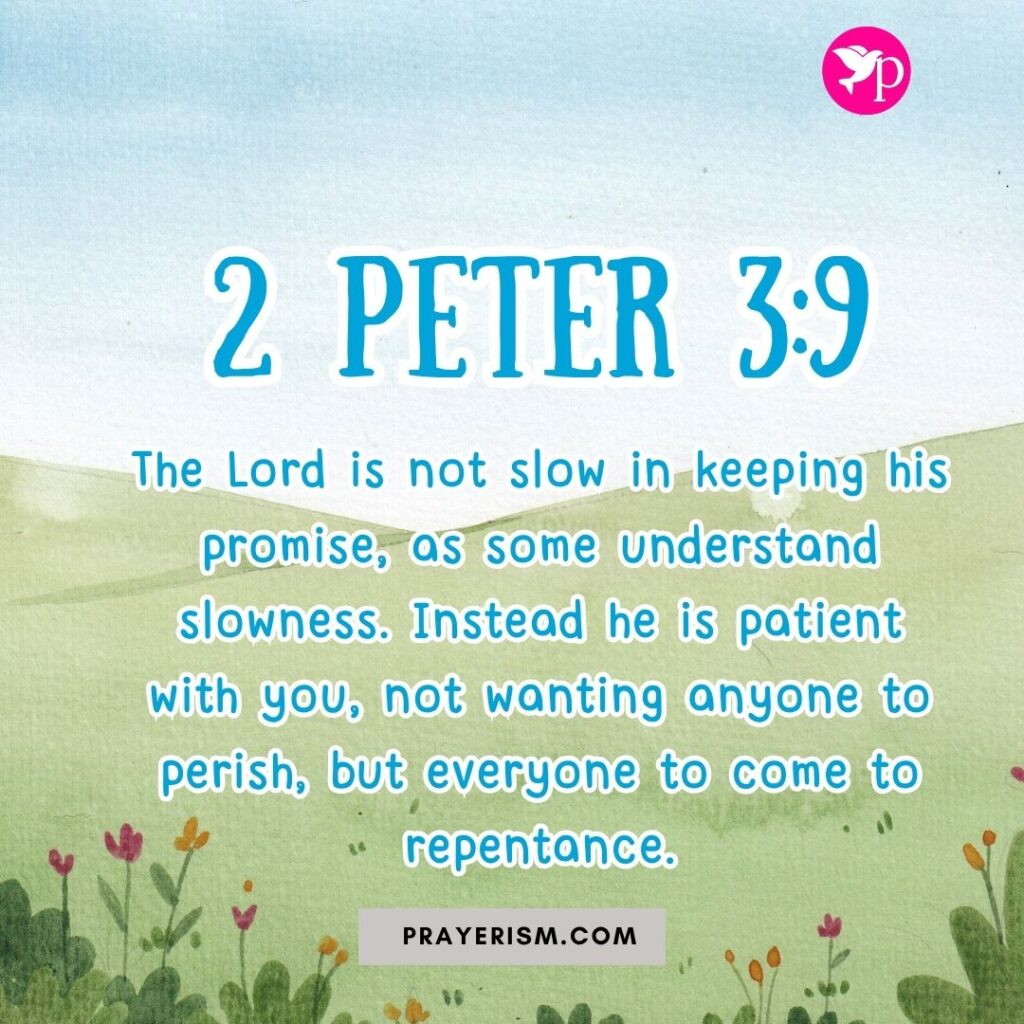
God’s patience looks like slowness from the outside. You’ve thought it yourself — “Why isn’t He doing something? Why is He letting this go on?”
But what looks like inaction is actually love making room. God is patient because He’s not willing to lose you. And maybe — just maybe — the patience you’re being asked to show right now is doing the same thing. Making room. Giving time. Refusing to give up on someone God isn’t willing to lose either.
13. Psalm 103:8 (NIV)
“The Lord is compassionate and gracious, slow to anger, abounding in love.”
Slow to anger. Abounding in love. That’s God’s default speed. Not quick to punish. Not easily provoked. Slow. Measured. Patient beyond any reasonable expectation.
You’ve tested that patience. I’ve tested it. We’ve all failed God in ways that should have exhausted His goodness — and it didn’t. Because His love isn’t based on our behavior. It’s based on His character. And His character is patience.
14. 1 Timothy 1:16 (NIV)
“But for that very reason I was shown mercy so that in me, the worst of sinners, Christ Jesus might display his immense patience as an example for those who would believe in him and receive eternal life.”
Paul — a man who had Christians killed — called himself the worst of sinners. And then said the reason God saved him was to put His immense patience on display. As an example.
God’s patience with Paul wasn’t just for Paul. It was for everyone who would come after, looking at their own failures and wondering if God was done with them. The answer was Paul’s whole life: no. He’s not done. He’s patient. Immensely patient.
15. Exodus 34:6 (NIV)
“And he passed in front of Moses, proclaiming, ‘The Lord, the Lord, the compassionate and gracious God, slow to anger, abounding in love and faithfulness.'”
This is God’s self-description. When He chose the words to define Himself — standing in front of Moses on the mountain — patience was at the center. Compassionate. Gracious. Slow to anger. Abounding in love.
When you’re patient with someone who doesn’t deserve it, you’re not just being nice. You’re being like God. You’re reflecting the deepest part of His character in the hardest possible context. That’s not weakness. That’s image-bearing at its finest.
Scriptures for Patience in Marriage When Love Feels Like Work
Can I say something that might get me emails? Marriage is the hardest patience assignment God ever gives you. Because you can walk away from a difficult coworker at 5 PM. You can distance yourself from a toxic friend. But the person you married sleeps three feet from you. And the same qualities that drew you to them can become the same ones that drive you to the edge.
These five verses are for the specific exhaustion of covenant love — the kind you promised to maintain regardless of how you feel today.
16. Ecclesiastes 4:9-10 (NIV)
“Two are better than one, because they have a good return for their labor: If either of them falls down, one can help the other up. But pity anyone who falls and has no one to help them up.”

If either falls, one can help the other up. That’s the design. Not “if either falls, one can point out how many times they’ve fallen before.” Not “if either falls, one can remind them they were warned.”
Help them up. Even when you’re tired. Even when this is the fifth time they’ve fallen in the same spot. The patience of marriage isn’t about keeping your composure. It’s about offering your hand again when everything in you wants to cross your arms.
17. 1 Peter 4:8 (NIV)
“Above all, love each other deeply, because love covers over a multitude of sins.”

Above all. Peter puts this at the top. Not communication. Not compatibility. Love. Deep love. The kind that covers — not exposes, not catalogs, not weaponizes — covers a multitude of sins.
In marriage, you will see every flaw your spouse has. Every weakness. Every failure. You’ll see them at their absolute worst. And patient love says “I see all of it and I’m still here.” Not because you’re blind. Because you chose to cover instead of uncover.
18. Song of Solomon 8:7 (NIV)
“Many waters cannot quench love; rivers cannot sweep it away. If one were to give all the wealth of one’s house for love, it would be utterly scorned.”
Many waters. Not gentle streams — waters. Floods. The overwhelming forces that try to drown love — financial stress, miscommunication, resentment, boredom, betrayal.
Love survives them. Not because love is naive. Because love, when it’s rooted in patience, is stronger than every flood that tries to sweep it away. Rivers cannot wash it out. And no amount of money can buy what it produces.
19. Ephesians 5:25 (NIV)
“Husbands, love your wives, just as Christ loved the church and gave himself up for her.”
Gave himself up. That’s the model. Not “loved the church when the church was lovable.” Gave himself up when the church was still a mess. Still unfaithful. Still wandering.
Patient love in marriage is sacrificial. It costs you something — your pride, your need to be right, your comfort, sometimes your entire evening. And the standard isn’t “love your spouse as much as you feel like loving them.” It’s “love as Christ loved.” Which was all the way.
20. Ruth 1:16 (NIV)
“But Ruth replied, ‘Don’t urge me to leave you or to turn back from you. Where you go I will go, and where you stay I will stay. Your people will be my people and your God my God.'”
Ruth said this to her mother-in-law. Not her husband — her mother-in-law. In a season of grief. With no guarantee of provision. She chose loyalty when leaving would have been easier.
Patient love doesn’t need a guarantee. It makes a commitment and holds it — not because the road is clear, but because the person beside you matters more than the convenience of walking alone.
Scriptures About Patience With People Who Keep Hurting You
We need to be honest about something. Some of you aren’t exhausted because the person you love is mildly annoying. You’re exhausted because they keep hurting you. The same wound in different packaging. The same pattern you’ve confronted and forgiven and confronted again.
These verses are for that specific weariness. And I want to be clear — patience doesn’t mean accepting abuse. It doesn’t mean pretending everything is fine. But it does mean something, even in the hardest relationships. Let me show you what.
21. Matthew 18:21-22 (NIV)
“Then Peter came to Jesus and asked, ‘Lord, how many times shall I forgive my brother or sister who sins against me? Up to seven times?’ Jesus answered, ‘I tell you, not seven times, but seventy-seven times.'”

Peter thought seven was generous. Jesus made the number absurd on purpose. Seventy-seven times — or seventy times seven, depending on your translation — isn’t a literal count. It’s a principle: stop keeping score.
That doesn’t mean you stay in an unsafe situation. It means you release the debt. You stop carrying the weight of what they owe you. Not for their sake. For yours. Because bitterness is heavier than forgiveness, and Jesus knows you can’t carry both.
22. Romans 12:17-18 (NIV)
“Do not repay anyone evil for evil. Be careful to do what is right in the eyes of everyone. If it is possible, as far as it depends on you, live at peace with everyone.”

“If it is possible.” Paul knew it’s not always possible. Some people don’t want peace. Some relationships can’t be repaired right now. And “as far as it depends on you” means you’re only responsible for your side of the equation.
Patient love does everything within its power to pursue peace. But it doesn’t carry the guilt when the other person refuses it. You can be patient and still have boundaries. You can love someone and still protect yourself from their harm.
23. Luke 6:27-28 (NIV)
“But to you who are listening I say: Love your enemies, do good to those who hate you, bless those who curse you, pray for those who mistreat you.”
Pray for those who mistreat you. Not pray about them — pray for them. There’s a world of difference.
Praying about someone keeps you at a distance. Praying for them pulls you into compassion whether you want it or not. You can’t genuinely ask God to bless someone and keep hating them at the same time. Prayer is the mechanism that turns patient endurance into patient love.
24. Romans 12:21 (NIV)
“Do not be overcome by evil, but overcome evil with good.”
Overcome evil with good. Not with silence. Not with avoidance. With good. Active, intentional, costly good.
This is the most aggressive form of patience in the Bible. It doesn’t just absorb the hit — it responds with something the aggressor didn’t expect. Kindness where cruelty was given. Grace where punishment was earned. That kind of response doesn’t make you vulnerable. It makes you dangerous — dangerous to the cycle of hurt that keeps repeating.
25. 1 Peter 2:23 (NIV)
“When they hurled their insults at him, he did not retaliate; when he suffered, he made no threats. Instead, he entrusted himself to him who judges justly.”
He entrusted himself to the one who judges justly. That’s where the patience came from. Jesus didn’t retaliate because He trusted His Father to handle it. He didn’t need to defend Himself because the Judge was already on the case.
When someone keeps hurting you, the patience to not retaliate doesn’t come from being a better person. It comes from trusting that God sees, God knows, and God will address it. You don’t have to be the judge, the jury, and the executioner. You just have to trust the one who is.
Scriptures About Patience as a Fruit of the Spirit, Not a Personality Trait
If you’ve been telling yourself “I’m just not a patient person,” I need to stop you right there. Patience is not a personality type. It’s not something you’re born with or without. According to Scripture, patience is a fruit of the Spirit — which means it grows. From a source outside of you. Over time.
And that changes everything about how you pursue it.
26. Galatians 5:22-23 (NIV)
“But the fruit of the Spirit is love, joy, peace, forbearance, kindness, goodness, faithfulness, gentleness and self-control. Against such things there is no law.”

Forbearance. That’s the word most translations use for patience here. And it’s a fruit — not a muscle you flex, not a skill you master, but a fruit that grows when you stay connected to the vine.
You don’t produce fruit by straining. You produce it by abiding. Staying close to God. Drawing from His Spirit. And patience — the kind that actually lasts in difficult relationships — grows out of that closeness, not out of your willpower.
27. John 15:4-5 (NIV)
“Remain in me, as I also remain in you. No branch can bear fruit by itself; it must remain in the vine. Neither can you bear fruit unless you remain in me. I am the vine; you are the branches. If you remain in me and I in you, you will bear much fruit; apart from me you can do nothing.”

Apart from me you can do nothing. Not “apart from me you can do less.” Nothing.
The patience you keep running out of? You’re running out because you’re trying to produce it yourself. Disconnected from the vine, the branch dries up. Doesn’t matter how strong the branch is — no vine, no fruit. Your patience isn’t refilled by trying harder. It’s refilled by staying closer.
28. 2 Peter 1:5-7 (NIV)
“For this very reason, make every effort to add to your faith goodness; and to goodness, knowledge; and to knowledge, self-control; and to self-control, perseverance; and to perseverance, godliness; and to godliness, mutual affection; and to mutual affection, love.”
Look at the progression. Self-control before perseverance. Perseverance before godliness. Godliness before affection. Affection before love. It’s a staircase — each step builds on the one before it.
You can’t skip to patient love without building self-control first. And self-control comes from knowledge, which comes from goodness, which comes from faith. The patience you need tomorrow is being built by the disciplines you practice today.
29. Isaiah 40:31 (NIV)
“But those who hope in the Lord will renew their strength. They will soar on wings like eagles; they will run and not grow weary, they will walk and not be faint.”
Renew. Not generate. Renew. The strength you need for patient love isn’t created from nothing — it’s restored from a source that never depletes.
If you’re weary from loving someone who takes everything you have, this verse isn’t telling you to push harder. It’s telling you to hope in the Lord. To bring your emptiness to the one who fills. To stop running on fumes and start running on a power source that doesn’t burn out.
30. Philippians 4:13 (NIV)
“I can do all this through him who gives me strength.”
All this. Including patience with the person who drives you crazy. Including love for the one who’s hardest to love. Including one more day of showing up when everything in you wants to shut down.
Not through willpower. Through Him. The strength for patient love comes from Christ — not as a slogan on a T-shirt, but as a literal supply of power for the specific moment you’re in.
Scriptures for the Slow, Invisible Work of Loving Someone Over Time
Nobody talks about this part. The unglamorous middle. The years of showing up for someone who doesn’t change as fast as you want them to. The quiet faithfulness that doesn’t get a testimony at church because nothing dramatic happened — you just didn’t quit.
These five verses are for the long game. For the love that’s measured in decades, not moments.
31. Galatians 6:9 (NIV)
“Let us not become weary in doing good, for at the proper time we will reap a harvest if we do not give up.”

At the proper time. Not at your time. Not when you’ve decided you’ve waited long enough. The proper time — God’s timing, which is never early and never late but almost always different from yours.
The harvest is coming. For the marriage you’ve been praying over. For the child who seems unreachable. For the relationship that feels like it’s going nowhere. But the condition is brutal in its simplicity: do not give up.
32. James 5:7-8 (NIV)
“Be patient, then, brothers and sisters, until the Lord’s coming. See how the farmer waits for the land to yield its valuable crop, patiently waiting for the autumn and spring rains. You too, be patient and stand firm, because the Lord’s coming is near.”
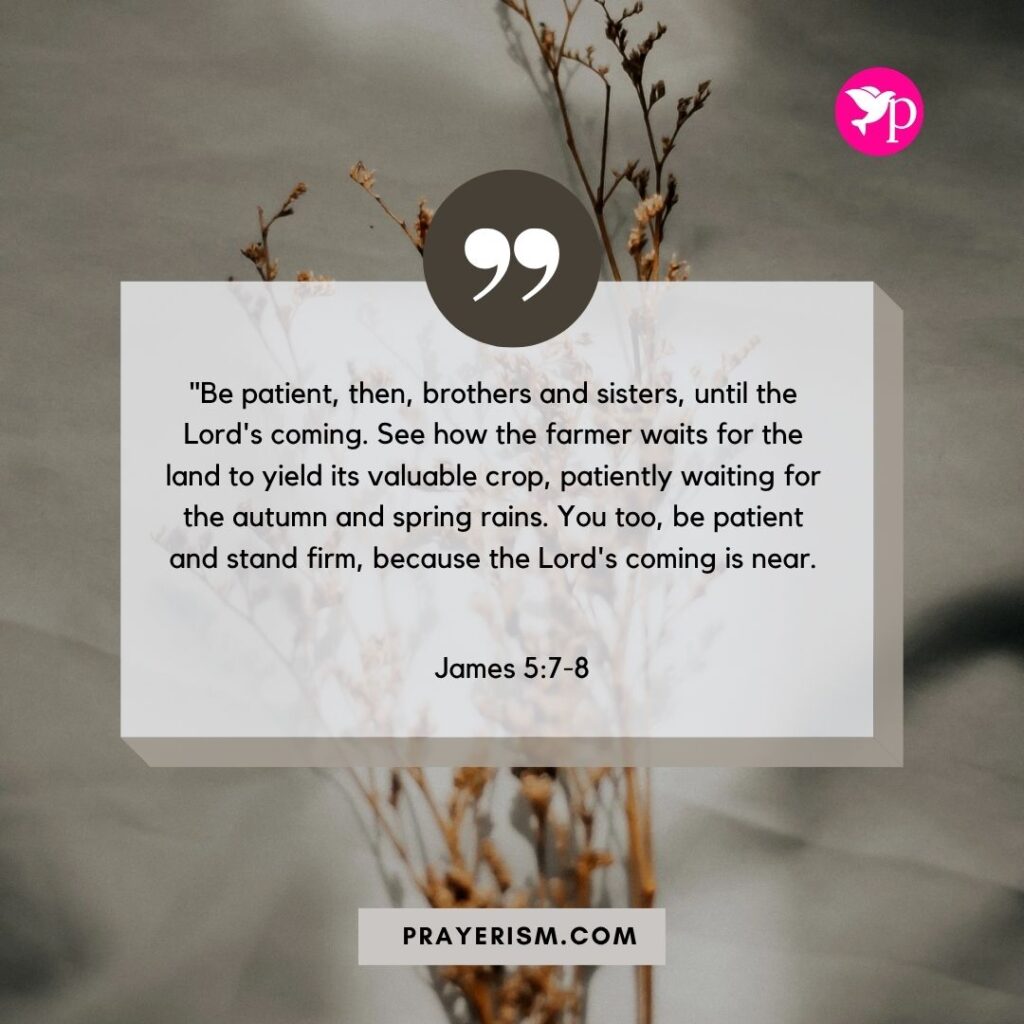
The farmer waits. That’s his job — not to make the rain come, not to force the crop up, but to wait. Patiently. Through seasons that look like nothing is happening underground.
Your patience in a difficult relationship is farm work. You’re planting, watering, waiting. And the growth is happening underneath where you can’t see it yet. Don’t pull up the seed just because the sprout hasn’t appeared on your schedule.
33. Hebrews 6:15 (NIV)
“And so after waiting patiently, Abraham received what was promised.”
After waiting patiently. Three words that cover twenty-five years. Twenty-five years of God promising something and Abraham not seeing it yet. Twenty-five years of doubt, questions, and the temptation to force the outcome himself — which he did, and it created a mess that lasted generations.
But after the waiting — after the patience — he received. The promise came. Not on his timeline. On God’s. And it was worth every year in between.
34. Lamentations 3:25-26 (NIV)
“The Lord is good to those whose hope is in him, to the one who seeks him; it is good to wait quietly for the salvation of the Lord.”
Wait quietly. Not anxiously. Not loudly. Quietly. With a settled confidence that God is moving even when you can’t hear His footsteps.
Some of you need to stop narrating your impatience and start practicing quiet hope. Not passive resignation — quiet trust. The kind that doesn’t need to announce itself because it’s too busy being anchored in something solid.
35. Habakkuk 2:3 (NIV)
“For the revelation awaits an appointed time; it speaks of the end and will not prove false. Though it linger, wait for it; it will certainly come and will not delay.”
It will certainly come. Not might. Not could. Will. Certainly. And it will not delay — not by God’s clock, even when it feels delayed by yours.
The change you’re waiting for. The breakthrough in that relationship. The moment your patience finally bears visible fruit. God has appointed a time for it. It’s not late. It’s just not yet.
Scriptures About Patience When You’re Waiting on God to Change Someone
This is the prayer you’ve prayed a thousand times: “God, change them.” And He hasn’t yet. Or He hasn’t in the way you wanted. Or He has, but so slowly that you can’t tell from where you’re standing.
These five verses speak to the specific agony of watching someone you love stay stuck — and trusting God with a timeline you can’t control.
36. Philippians 1:6 (NIV)
“Being confident of this, that he who began a good work in you will carry it on to completion until the day of Christ Jesus.”

In you. And in them. The same God who started a work in your life is working in theirs — even when you can’t see evidence of it. Even when they seem unchanged. Even when the behavior that exhausts you hasn’t shifted.
God finishes what He starts. Your job isn’t to complete the work in them. It’s to trust the one who will.
37. Romans 8:28 (NIV)
“And we know that in all things God works for the good of those who love him, who have been called according to his purpose.”

All things. Including the difficult season in your relationship. Including the pain of loving someone who isn’t where you want them to be. God is working — not just in spite of the difficulty, but through it. Shaping something in you and in them that the easy season never could have produced.
38. Psalm 27:14 (NIV)
“Wait for the Lord; be strong and take heart and wait for the Lord.”
Wait. Be strong. Take heart. Wait.
David says it twice. Wait for the Lord. As if he knows you’ll try once and give up. As if he understands that waiting requires a double commitment — the initial decision and the daily re-decision. The patience to keep choosing patience even when patience hasn’t produced anything visible yet.
39. Psalm 40:1-2 (NIV)
“I waited patiently for the Lord; he turned to me and heard my cry. He lifted me out of the slimy pit, out of the mud and mire; he set my feet on a rock and gave me a firm place to stand.”
I waited patiently, and He turned. He heard. He lifted. He set my feet on solid ground.
The waiting wasn’t wasted. Every day David spent in the pit, God was moving toward him. And when God finally acted, the ground He placed David on wasn’t shaky. It was rock. Firm. Unshakable.
The waiting isn’t the punishment. The waiting is the setup for the solid ground that’s coming.
40. 2 Thessalonians 3:5 (NIV)
“May the Lord direct your hearts into God’s love and Christ’s perseverance.”
Christ’s perseverance. Not yours. His.
The patience you need for this relationship isn’t manufactured from your own reserves. It’s directed — guided, channeled, supplied — by the Lord Himself into your heart. Christ’s perseverance became His through suffering, through waiting, through loving people who didn’t love Him back. And that same perseverance is available to you.
You’re not borrowing patience from a stranger. You’re receiving it from the one who endured more than you ever will — and never stopped loving.
Scriptures for When You’re Ready to Love Patiently Again
We’ve walked through a lot. The definition of patient love. The loss of patience. God’s patience with you. The hardest relationships. The long middle. The waiting.
This final section is for the moment you put this article down and walk back into the room where the difficult person lives. These five verses are fuel for the next conversation, the next morning, the next decision to show up when leaving would be easier.
41. 1 Corinthians 16:14 (NIV)
“Do everything in love.”

Everything. Not most things. Not the things that come easy. Everything. The correction. The confrontation. The boundary. The forgiveness. All of it — in love.
Patient love isn’t a feeling you wait to have. It’s a filter you put on every action. Before you speak, run it through love. Before you act, run it through love. Before you decide, run it through love. Everything.
42. Romans 15:5-6 (NIV)
“May the God who gives endurance and encouragement give you the same attitude of mind toward each other that Christ Jesus had, so that with one mind and one voice you may glorify the God and Father of our Lord Jesus Christ.”

The God who gives endurance. Not the God who demands it. Gives it. Freely. To the person who needs it most.
If your endurance is gone, you’re not disqualified. You’re in exactly the right position to receive more. God doesn’t give endurance to people who don’t need it. He gives it to the ones who’ve run out.
43. Hebrews 10:36 (NIV)
“You need to persevere so that when you have done the will of God, you will receive what he has promised.”
You need to persevere. Not “it would be nice if you persevered.” You need to. Because there’s something on the other side — something promised, something specific — that you only receive by staying in the race.
The relationship that’s testing your patience isn’t a detour from God’s will. It might be the exact terrain where His promises are fulfilled.
44. Romans 5:3-5 (NIV)
“Not only so, but we also glory in our sufferings, because we know that suffering produces perseverance; perseverance, character; and character, hope. And hope does not put us to shame, because God’s love has been poured out into our hearts through the Holy Spirit, who has been given to us.”
Suffering produces perseverance. Perseverance produces character. Character produces hope. It’s a chain — and the first link is the suffering you’re in right now.
Which means this exhaustion isn’t pointless. It’s producing something in you. Something that can’t be built any other way. And the end of the chain isn’t more suffering — it’s hope. Real hope. The kind that doesn’t put you to shame because it’s fueled by God’s love poured directly into your heart.
45. 1 John 4:19 (NIV)
“We love because he first loved us.”
Seven words. The entire engine of patient love in a single sentence.
You don’t love patiently because you’re naturally good at it. You love because you were loved first. Every ounce of patience you’ve ever extended to someone else is borrowed from the patience that was first extended to you — by a God who loved you when you were the difficult one. The exhausting one. The one who kept falling into the same patterns and needed grace again and again.
He loved you first. And that love — His love, not yours — is the only supply that never runs dry.
I know you’re tired. I know the person you love is hard to love right now. I know patience feels like it costs more than you have and produces less than you need.
But I also know this: the fact that you’re still here — still searching for scriptures, still trying to love well, still refusing to quit on someone who’s testing everything in you — that’s not weakness.
That’s love doing exactly what love does.
It stays. It endures. It outlasts the feelings that told you to leave. Not because it’s easy. Because it’s real. And real love — patient, costly, Spirit-fueled love — doesn’t run out. It runs through you from a source that never empties.
So go back into the room. Have the conversation. Show up again tomorrow. Not because you have enough patience — but because the one who does lives inside you and hasn’t stopped giving.
A Prayer for Patience and Love in Difficult Relationships
Gracious Father,
I’m running on empty. You see the relationship that’s draining me. You know the person I’m struggling to love with patience. You’ve watched me try and fail and try again.
I can’t do this with what I have left. So I’m asking for what only You can give — Your patience, not mine. Your love, not the version I’ve been manufacturing on my own.
Help me see this person the way You see them. Not through my frustration. Not through the record of wrongs I’ve been keeping. Through Your eyes — the ones that looked at me when I was at my worst and said “I love you still.”
Give me the patience to stay when I want to leave. The self-control to listen when I want to speak. The humility to forgive when I want to remind them of everything they’ve done.
And where I need boundaries, give me the wisdom to set them with love instead of anger. Where I need distance, help me take it without bitterness. Where I need to confront, let me do it with the gentleness of someone who remembers how much grace they’ve been given.
You have been so patient with me. Let that patience flow through me to the person who needs it most today.
In Jesus’ name, Amen.
Frequently Asked Questions
What does “love is patient” mean in the Bible?
“Love is patient” comes from 1 Corinthians 13:4, where Paul is defining the characteristics of genuine love. The Greek word for patience here is makrothumei, which literally means “long-tempered” — the opposite of short-tempered. It describes love that endures provocation without retaliating, that absorbs frustration without lashing out, and that gives people time and space to grow without demanding instant change.
How do I have patience with someone who keeps hurting me?
Patience with someone who repeatedly hurts you requires two things that seem contradictory but work together: grace and boundaries. Grace means releasing the debt — choosing not to retaliate, praying for the person, and trusting God to be the judge (1 Peter 2:23, Romans 12:19). Boundaries mean protecting yourself from ongoing harm — because patience does not mean allowing abuse or staying in situations that are destroying you.
Is patience a fruit of the Spirit?
Yes. Patience — or “forbearance” in some translations — is listed as one of the nine fruits of the Spirit in Galatians 5:22-23, alongside love, joy, peace, kindness, goodness, faithfulness, gentleness, and self-control. This is significant because it means patience isn’t a personality trait you either have or lack. It’s a spiritual fruit that grows through your relationship with the Holy Spirit.
Just as a branch produces fruit by staying connected to the vine (John 15:4-5), you produce patience by staying connected to God through prayer, Scripture, and daily dependence. If you feel like you’re “just not a patient person,” the biblical answer isn’t to try harder — it’s to draw closer to the source.
What does the Bible say about being patient in relationships?
The Bible speaks extensively about patience in relationships. Ephesians 4:2 instructs believers to bear with one another in love. Colossians 3:12-13 tells us to clothe ourselves with patience and to forgive as the Lord forgave us. Proverbs 15:18 teaches that patience calms quarrels while hot tempers stir up conflict. Romans 12:17-18 advises pursuing peace as far as it depends on you.
How was God patient in the Bible?
God’s patience is one of the most consistent themes in Scripture. He described Himself as “slow to anger, abounding in love” (Exodus 34:6). He was patient with Israel through centuries of rebellion, idolatry, and unfaithfulness — sending prophets, warnings, and opportunities to repent before bringing judgment. He was patient with Nineveh, a violent enemy nation, giving them a chance to turn from their ways through Jonah’s preaching.
In the New Testament, Paul describes his own conversion as a display of Christ’s “immense patience” — saving the worst of sinners as an example for everyone who would come after (1 Timothy 1:16). And 2 Peter 3:9 says God’s apparent slowness isn’t delay but patience, because He doesn’t want anyone to perish. God’s patience isn’t passive tolerance. It’s active love creating space for repentance and transformation.
How do I know the difference between patience and enabling?
Patience says “I will love you through this process of growth.” Enabling says “I will protect you from the consequences of your choices.” Patience allows someone to face the natural results of their actions while still supporting them emotionally and spiritually. Enabling removes consequences, which actually prevents the growth that patience is waiting for.